Lower receiver
Palmetto State Armory AR-15 "Stealth" Stripped Lower Receiver
Palmetto State Armory's forged stripped lower with no logo: "this lower features no rollmark on the left hand side, just the caliber, model and serial". "These forged lowers are quality made by a mil-spec contractor using 7075-T6 aluminum and are marked "MULTI" to accommodate most builds. Finish is Black Hardcoat Anodize per MIL-8625 Type 3 class 2." "Serial Number prefix is "PA". Fire selector is marked "Safe" and "Fire"." (its page, as saved 2026-10-12). No trigger guard: a separate one pins into its ears.
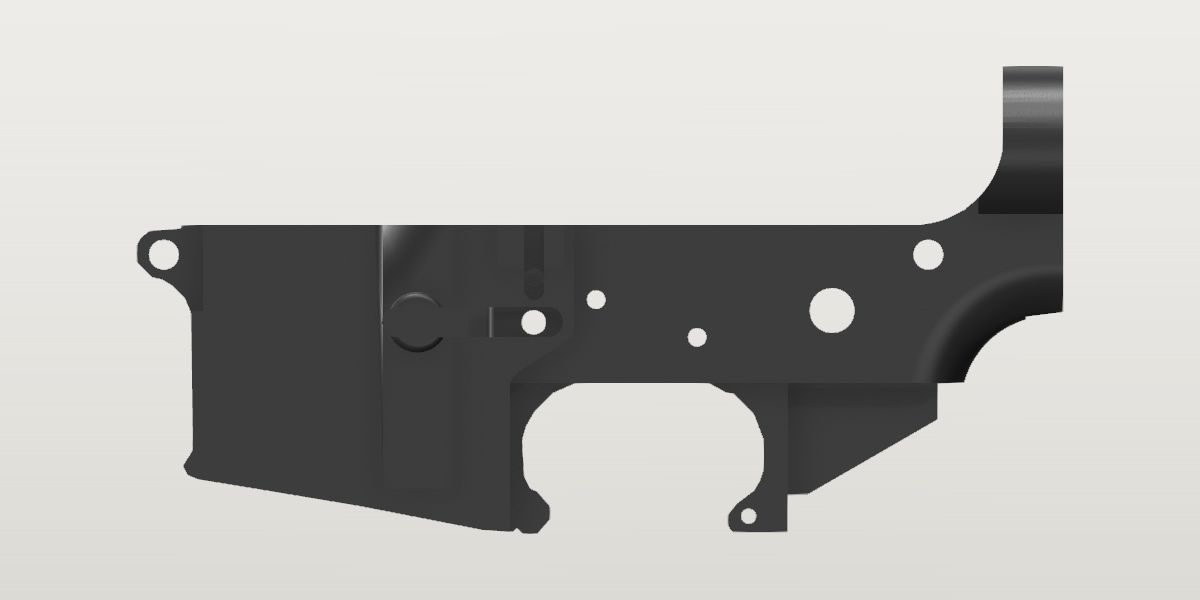
- Weight
- 8.47 oz ± 0.85 oz Provisionalworked out: This part's own model's metal: the closed volume of app/public/models/psa-stealth-stripped-lower.glb as its script built it (5.189 cubic inches: the traced outline at the Army drawing's widths, its pocket, well, bore and holes cut; the manifest's volume_in3) times what a cubic inch of 7075 weighs (std.density.aluminium_7075, 1.632 oz): 5.189 x 1.632 = 8.47 oz. The page: 'Forged 7075 Aluminum', '7075-T6 aluminum'.
- Lowest price
- $79.99 at Palmetto State Armory, read Oct 12, 2026
- Maker's number
- 39296
- Colour
- Black (placeholder)
- Drawn as
- modelled
- Maker's page
- palmettostatearmory.com
In “22RB .22 LR rifle”, a build on the start page, in place of its Battle Arms Development Workhorse stripped lower.
Its figures
Every figure the site draws and checks it by, with where it came from. Open one for each source's reading, and why one is used where they differ.
Receiver maximum width (Z)0.88 in ± 0.008 in 22.4 mmConfirmedWorked out: {std.ar15.lower_body_width}
Worked out 0.88 in ± 0.008 in used
{std.ar15.lower_body_width}, harvested
Palmetto State Armory: 'These forged lowers are quality made by a mil-spec contractor using 7075-T6 aluminum' (the page as the user saved it, 2026-10-12). The body's width is the Army drawing's (8448608, Section C-C). No page states a width and no photo on file looks along the receiver or down onto it.
The body's is the drawing's; the well's walls (std.ar15.magwell_outside_width) and the tower's ring (std.ar15.buffer_tower_od) stand wider and are drawn at the drawing's too.
Receiver extension (bore) axis above the takedown pin centre0.877 in ± 0.0015 in 22.3 mmConfirmedWorked out: {std.ar15.bore_axis_y}
Worked out 0.8775 in ± 0.0015 in used
{std.ar15.bore_axis_y}, harvested
A mil-spec lower: the threaded hole's centre is the drawing's (.629 above the deck). The left photo is consistent with it and no more: the ring is seen from ahead and its rims aren't circles a 546 px picture can be fitted to (its silhouette tops out at 1.605 for the drawing's 1.5735: the ring's near rim, 0.7 in nearer the lens than the centre plane, seen from a lens that stands below its top's level).
Magazine seat, X (a seated magazine's frame origin ahead of the takedown pin)3.491 in ± 0.03 in 88.7 mmProvisionalWorked out: {bad-workhorse-lower.magazine_seat_x}
Worked out 3.4915 in ± 0.03 in used
{bad-workhorse-lower.magazine_seat_x}, from the site owner
Where a magazine seats in a mil-spec well: from the Army drawing's well and catch slot and the user's own magazine, recorded on the Workhorse. This lower's well is mil-spec by its maker's sentence, and its left photo has the catch's slot and hole where the drawing puts them (the hole at X 3.289, Y -0.564 for the drawing's 3.291, -0.565). No photo of a magazine seated in it is on file.
Magazine seat, Y (the feed-lip top of a seated magazine)1.003 in ± 0.05 in 25.5 mmProvisionalWorked out: {bad-workhorse-lower.magazine_seat_y}
Worked out 1.003 in ± 0.05 in used
{bad-workhorse-lower.magazine_seat_y}, from the site owner
As magazine_seat_x: the standard well's and the catch's, not this receiver's outside.
Receiver underside behind the step (where a grip's flat top bears), Y-1.071 in ± 0.03 in -27.2 mmProvisionalPhoto: left side on white: Palmetto State Armory's gallery picture 7a4a7701.jpg (546 x 546), from the page the user saved 2026-10-12
Photo -1.071 in ± 0.03 in used
left side on white: Palmetto State Armory's gallery picture 7a4a7701.jpg (546 x 546), from the page the user saved 2026-10-12, from the site owner
Scale: frame from the reviewed holes takedown, pivot (59.4 px/in, rms 0.000 in over 2 points). Read by y_min in x [-0.25, -0.12] of the traced outline (tools/trace.py)
The outline's flat just behind the lug's rear face: the left side's reading of where a grip's flat top bears (the seat itself is the drawing's: grip_seat_y).
The outline's flat just behind the lug's rear face: the left side's reading of where a grip's flat top bears. The seat itself is the drawing's (grip_seat_y).
Grip seat, Y (the underside a grip's flat top bears on, at the takedown pin's X)-1.069 in ± 0.011 in -27.2 mmConfirmedWorked out: {std.ar15.deck_y} - {std.ar15.grip_seat_below_deck}
Worked out -1.0695 in ± 0.0115 in used
{std.ar15.deck_y} - {std.ar15.grip_seat_below_deck}, harvested
A mil-spec lower: the flat the lug hangs from is the drawing's, 1.318 ±.010 below the deck.
Photo -1.07 in ± 0.03 in
left side on white: Palmetto State Armory's gallery picture 7a4a7701.jpg, 546 x 546, from the page the user saved 2026-10-12, from the site owner
Scale: frame from the reviewed holes takedown (425.8, 245.9), pivot (47.0, 246.3) = (0, 0), (6.375, 0): 59.42 px/in; checked at the selector's, trigger's, hammer's, guard's and catch's holes, each within 0.025 in of the Army drawing's place. Read by the line where the body's face ends over the lug (the lug stands 0.25 in behind the face and is darker), read on a 5x crop with a 0.1 in grid in the frame (g-rear.png) from X -0.09 to 1.1; ± is 2 px
The drawing dimensions it, and the left photo has the body's lower edge over the lug on it within a pixel.
Grip shelf start (the step behind the grip: the lug's rear face), X-0.095 in ± 0.025 in -2.4 mmProvisionalPhoto: left side on white: Palmetto State Armory's gallery picture 7a4a7701.jpg (546 x 546), from the page the user saved 2026-10-12
Photo -0.095 in ± 0.025 in used
left side on white: Palmetto State Armory's gallery picture 7a4a7701.jpg (546 x 546), from the page the user saved 2026-10-12, from the site owner
Scale: frame from the reviewed holes takedown, pivot (59.4 px/in, rms 0.000 in over 2 points). Read by x_min in x [-0.2, 0.6] in y [-1.3, -1.1] of the traced outline (tools/trace.py)
The lug's rear face (an upright edge between Y -1.08 and -1.35).
The lug's rear face as the outline has it; the drawing's is -0.075 (std.ar15.receiver_rear_x + grip_lug_front_from_rear_face - grip_lug_length), which the model uses.
Receiver underside above the trigger opening, Y-1.085 in ± 0.026 in -27.6 mmProvisionalPhoto: left side on white: Palmetto State Armory's gallery picture 7a4a7701.jpg (546 x 546), from the page the user saved 2026-10-12
Photo -1.085 in ± 0.026 in used
left side on white: Palmetto State Armory's gallery picture 7a4a7701.jpg (546 x 546), from the page the user saved 2026-10-12, from the site owner
Scale: frame from the reviewed holes takedown, pivot (59.4 px/in, rms 0.000 in over 2 points). Read by y_min in x [1.95, 2.85] of the traced outline (tools/trace.py)
The body's lower edge above the trigger guard's opening.
The grip lug's sloped face, from the vertical60° ± 2°ConfirmedWorked out: {std.ar15.grip_lug_face_angle}
Worked out 60 deg ± 2 deg used
{std.ar15.grip_lug_face_angle}, harvested
A mil-spec lower: the lug is the drawing's (60° ±2°).
Photo 61.5 deg ± 2 deg
left side on white: Palmetto State Armory's gallery picture 7a4a7701.jpg, 546 x 546, from the page the user saved 2026-10-12, from the site owner
Scale: frame from the reviewed holes takedown (425.8, 245.9), pivot (47.0, 246.3) = (0, 0), (6.375, 0): 59.42 px/in; checked at the selector's, trigger's, hammer's, guard's and catch's holes, each within 0.025 in of the Army drawing's place. Read by the lug's sloped lower edge on the 5x gridded crop (g-rear.png), from (-0.09, -1.39) to (1.00, -1.98): its lean from the vertical over 1.09 in; ± is 2 px at each end
The drawing's; the photo's is within its ±.
The check that this lower's lug is the drawing's: in a square view of the left side the lug shows whole under the body's edge.
The grip lug's rear face (under the takedown pin), X-0.075 in ± 0.025 in -1.9 mmConfirmedWorked out: {std.ar15.receiver_rear_x} + {std.ar15.grip_lug_front_from_rear_face} - {std.ar15.grip_lug_length}
Worked out -0.075 in ± 0.025 in used
{std.ar15.receiver_rear_x} + {std.ar15.grip_lug_front_from_rear_face} - {std.ar15.grip_lug_length}, harvested
A mil-spec lower: the lug ends 2.300 ahead of the rear face and is 1.25 long.
Photo -0.09 in ± 0.03 in
left side on white: Palmetto State Armory's gallery picture 7a4a7701.jpg, 546 x 546, from the page the user saved 2026-10-12, from the site owner
Scale: frame from the reviewed holes takedown (425.8, 245.9), pivot (47.0, 246.3) = (0, 0), (6.375, 0): 59.42 px/in; checked at the selector's, trigger's, hammer's, guard's and catch's holes, each within 0.025 in of the Army drawing's place. Read by the lug's rear face on the 5x gridded crop (g-rear.png), between Y -1.07 and -1.39; ± is 2 px
The drawing's; the photo has the face 0.015 behind it, inside its ±.
The grip lug's bottom flat (where its sloped face ends, behind the trigger guard's ears), Y-2 in ± 0.021 in -50.8 mmConfirmedWorked out: {std.ar15.deck_y} - {std.ar15.grip_seat_below_deck} - {std.ar15.grip_lug_depth}
Worked out -1.9995 in ± 0.0215 in used
{std.ar15.deck_y} - {std.ar15.grip_seat_below_deck} - {std.ar15.grip_lug_depth}, harvested
A mil-spec lower: the flat is .93 below the seat.
Photo -1.98 in ± 0.03 in
left side on white: Palmetto State Armory's gallery picture 7a4a7701.jpg, 546 x 546, from the page the user saved 2026-10-12, from the site owner
Scale: frame from the reviewed holes takedown (425.8, 245.9), pivot (47.0, 246.3) = (0, 0), (6.375, 0): 59.42 px/in; checked at the selector's, trigger's, hammer's, guard's and catch's holes, each within 0.025 in of the Army drawing's place. Read by the flat at the sloped face's foot on the 5x gridded crop (g-rear.png), X 1.0 to 1.17; ± is 2 px
The drawing's; the photo has the flat 0.02 above it, inside its ±.
The rear underside (behind the grip's lug, under the tower), the radius of its arc on the centre plane0.75 in ± 0.01 in 19 mmProvisionalWorked out: {std.ar15.rear_underside_arc_r}
Worked out 0.75 in ± 0.01 in used
{std.ar15.rear_underside_arc_r}, harvested
The reference CAD model's arc on a mil-spec forging, about the model's centre (std.ar15.rear_underside_arc_center_x, _below_seat).
Photo 0.771 in ± 0.03 in
left side on white: Palmetto State Armory's gallery picture 7a4a7701.jpg, 546 x 546, from the page the user saved 2026-10-12, from the site owner
Scale: frame from the reviewed holes takedown (425.8, 245.9), pivot (47.0, 246.3) = (0, 0), (6.375, 0): 59.42 px/in; checked at the selector's, trigger's, hammer's, guard's and catch's holes, each within 0.025 in of the Army drawing's place. Read by the traced outline's five points along the underside from X -0.81 to -0.29 (tools/trace.py), each one's distance from the reference model's centre (-1.0238, -1.2623): 0.776, 0.773, 0.773, 0.774, 0.760; their mean; ± is 2 px
The reference model's; the photo's silhouette runs 0.01 to 0.026 outside it all along, inside its ±.
The check that this forging's rear underside is the reference model's, which the model draws (std.ar15.rear_underside_*): in a square view the silhouette's lower edge there is the centre plane's line.
The trigger guard's rear ears, their rear face (where the grip's lug ends), X1.175 in ± 0.015 in 29.8 mmConfirmedWorked out: {std.ar15.receiver_rear_x} + {std.ar15.grip_lug_front_from_rear_face}
Worked out 1.175 in ± 0.015 in used
{std.ar15.receiver_rear_x} + {std.ar15.grip_lug_front_from_rear_face}, harvested
A mil-spec lower: the lug ends at the ears 2.300 ahead of the rear face.
Photo 1.17 in ± 0.03 in
left side on white: Palmetto State Armory's gallery picture 7a4a7701.jpg, 546 x 546, from the page the user saved 2026-10-12, from the site owner
Scale: frame from the reviewed holes takedown (425.8, 245.9), pivot (47.0, 246.3) = (0, 0), (6.375, 0): 59.42 px/in; checked at the selector's, trigger's, hammer's, guard's and catch's holes, each within 0.025 in of the Army drawing's place. Read by the ears' rear face on the 5x gridded crop (g-rear.png), from the lug's flat down to the ear's bottom; ± is 2 px
The drawing's; the photo's edge is on it.
Trigger guard front ear hole, X3.342 in ± 0.007 in 84.9 mmConfirmedWorked out: {std.ar15.trigger_guard_front_x}
Worked out 3.3425 in ± 0.007 in used
{std.ar15.trigger_guard_front_x}, harvested
A mil-spec lower: the hole is the drawing's. It goes into the right ear only, from its spotface: the left photo doesn't show it.
Trigger guard front ear hole, Y-2.18 in ± 0.01 in -55.4 mmConfirmedWorked out: {std.ar15.trigger_guard_rear_y}
Worked out -2.18 in ± 0.01 in used
{std.ar15.trigger_guard_rear_y}, harvested
The drawing's side elevation has the guard's two holes on one centre line, 2.18 below the takedown pin (sheet 1 of 8448608). Not seen on the left photo.
Trigger guard rear ear hole, X1.498 in ± 0.01 in 38.1 mmConfirmedWorked out: {std.ar15.trigger_guard_rear_x}
Worked out 1.4985 in ± 0.01 in used
{std.ar15.trigger_guard_rear_x}, harvested
A mil-spec lower: the hole is the drawing's.
Photo 1.493 in ± 0.025 in
left side on white: Palmetto State Armory's gallery picture 7a4a7701.jpg, 546 x 546, from the page the user saved 2026-10-12, from the site owner
Scale: frame from the reviewed holes takedown (425.8, 245.9), pivot (47.0, 246.3) = (0, 0), (6.375, 0): 59.42 px/in; checked at the selector's, trigger's, hammer's, guard's and catch's holes, each within 0.025 in of the Army drawing's place. Read by the centroid of the hole's see-through, weighted by brightness, which is where the receiver's centre plane shows it; ± is 1.5 px (a see-through 8 to 22 px across, part of it hidden by the bore's wall)
The drawing's; the photo has it 0.005 behind.
Trigger guard rear ear hole, Y-2.18 in ± 0.01 in -55.4 mmConfirmedWorked out: {std.ar15.trigger_guard_rear_y}
Worked out -2.18 in ± 0.01 in used
{std.ar15.trigger_guard_rear_y}, harvested
A mil-spec lower: the hole is the drawing's.
Photo -2.168 in ± 0.025 in
left side on white: Palmetto State Armory's gallery picture 7a4a7701.jpg, 546 x 546, from the page the user saved 2026-10-12, from the site owner
Scale: frame from the reviewed holes takedown (425.8, 245.9), pivot (47.0, 246.3) = (0, 0), (6.375, 0): 59.42 px/in; checked at the selector's, trigger's, hammer's, guard's and catch's holes, each within 0.025 in of the Army drawing's place. Read by the centroid of the hole's see-through, weighted by brightness, which is where the receiver's centre plane shows it; ± is 1.5 px (a see-through 8 to 22 px across, part of it hidden by the bore's wall)
The drawing's (2.18 below the takedown pin); the photo reads 0.012 high, inside its ±.
Trigger pin hole centre, X1.928 in ± 0.004 in 49 mmConfirmedWorked out: {std.ar15.trigger_pin_x}
Worked out 1.928 in ± 0.004 in used
{std.ar15.trigger_pin_x}, harvested
A mil-spec lower: the hole is the drawing's.
Photo 1.916 in ± 0.025 in
left side on white: Palmetto State Armory's gallery picture 7a4a7701.jpg, 546 x 546, from the page the user saved 2026-10-12, from the site owner
Scale: frame from the reviewed holes takedown (425.8, 245.9), pivot (47.0, 246.3) = (0, 0), (6.375, 0): 59.42 px/in; checked at the selector's, trigger's, hammer's, guard's and catch's holes, each within 0.025 in of the Army drawing's place. Read by the centroid of the hole's see-through, weighted by brightness, which is where the receiver's centre plane shows it; ± is 1.5 px (a see-through 8 to 22 px across, part of it hidden by the bore's wall)
The drawing's; the photo has it 0.012 behind, inside its ±.
Trigger pin hole centre, Y-0.689 in ± 0.0035 in -17.5 mmConfirmedWorked out: {std.ar15.trigger_pin_y}
Worked out -0.689 in ± 0.0035 in used
{std.ar15.trigger_pin_y}, harvested
A mil-spec lower: the hole is the drawing's.
Photo -0.688 in ± 0.025 in
left side on white: Palmetto State Armory's gallery picture 7a4a7701.jpg, 546 x 546, from the page the user saved 2026-10-12, from the site owner
Scale: frame from the reviewed holes takedown (425.8, 245.9), pivot (47.0, 246.3) = (0, 0), (6.375, 0): 59.42 px/in; checked at the selector's, trigger's, hammer's, guard's and catch's holes, each within 0.025 in of the Army drawing's place. Read by the centroid of the hole's see-through, weighted by brightness, which is where the receiver's centre plane shows it; ± is 1.5 px (a see-through 8 to 22 px across, part of it hidden by the bore's wall)
The drawing's; the photo has it on it.
Hammer pin hole centre, X2.771 in ± 0.004 in 70.4 mmConfirmedWorked out: {std.ar15.hammer_pin_x}
Worked out 2.771 in ± 0.004 in used
{std.ar15.hammer_pin_x}, harvested
A mil-spec lower: the hole is the drawing's.
Photo 2.747 in ± 0.025 in
left side on white: Palmetto State Armory's gallery picture 7a4a7701.jpg, 546 x 546, from the page the user saved 2026-10-12, from the site owner
Scale: frame from the reviewed holes takedown (425.8, 245.9), pivot (47.0, 246.3) = (0, 0), (6.375, 0): 59.42 px/in; checked at the selector's, trigger's, hammer's, guard's and catch's holes, each within 0.025 in of the Army drawing's place. Read by the centroid of the hole's see-through, weighted by brightness, which is where the receiver's centre plane shows it; ± is 1.5 px (a see-through 8 to 22 px across, part of it hidden by the bore's wall)
Photo 2.775 in ± 0.008 in
the left side round the selector's hole, close: Palmetto State Armory's gallery picture 7a4a7703.jpg, 546 x 546, from the page the user saved 2026-10-12, from the site owner
Scale: frame from the near rims of the selector's and the trigger's holes at the Army drawing's places (std.ar15.selector_x/_y, trigger_pin_x/_y): 187.85 px/in, turned 0.09 degrees; each rim a circle fitted to where the hole gives way to the face. Read by the hole's near rim, a circle fitted to its edge (px 36.81, 232.91), in the frame the other two holes set: an independent reading of where the hammer's hole is from the trigger's and the selector's; ± is 1.5 px
The drawing's. The close-up, framed by the selector's and trigger's holes, has the hammer's 0.004 ahead of it; the whole view's see-through (8 px across) reads 0.024 behind, inside its ±: the worst of the five holes the frame was checked at.
Hammer pin hole centre, Y-0.375 in ± 0.002 in -9.5 mmConfirmedWorked out: {std.ar15.hammer_pin_y}
Worked out -0.375 in ± 0.002 in used
{std.ar15.hammer_pin_y}, harvested
A mil-spec lower: the hole is the drawing's.
Photo -0.383 in ± 0.025 in
left side on white: Palmetto State Armory's gallery picture 7a4a7701.jpg, 546 x 546, from the page the user saved 2026-10-12, from the site owner
Scale: frame from the reviewed holes takedown (425.8, 245.9), pivot (47.0, 246.3) = (0, 0), (6.375, 0): 59.42 px/in; checked at the selector's, trigger's, hammer's, guard's and catch's holes, each within 0.025 in of the Army drawing's place. Read by the centroid of the hole's see-through, weighted by brightness, which is where the receiver's centre plane shows it; ± is 1.5 px (a see-through 8 to 22 px across, part of it hidden by the bore's wall)
Photo -0.377 in ± 0.008 in
the left side round the selector's hole, close: Palmetto State Armory's gallery picture 7a4a7703.jpg, 546 x 546, from the page the user saved 2026-10-12, from the site owner
Scale: frame from the near rims of the selector's and the trigger's holes at the Army drawing's places (std.ar15.selector_x/_y, trigger_pin_x/_y): 187.85 px/in, turned 0.09 degrees; each rim a circle fitted to where the hole gives way to the face. Read by the hole's near rim, a circle fitted to its edge (px 36.81, 232.91), in the frame the other two holes set; ± is 1.5 px
The drawing's; the close-up has it 0.002 low, the whole view 0.008 low.
Safety selector hole centre, X0.803 in ± 0.004 in 20.4 mmConfirmedWorked out: {std.ar15.selector_x}
Worked out 0.803 in ± 0.004 in used
{std.ar15.selector_x}, harvested
A mil-spec lower: the hole is the drawing's.
Photo 0.799 in ± 0.025 in
left side on white: Palmetto State Armory's gallery picture 7a4a7701.jpg, 546 x 546, from the page the user saved 2026-10-12, from the site owner
Scale: frame from the reviewed holes takedown (425.8, 245.9), pivot (47.0, 246.3) = (0, 0), (6.375, 0): 59.42 px/in; checked at the selector's, trigger's, hammer's, guard's and catch's holes, each within 0.025 in of the Army drawing's place. Read by the centroid of the hole's see-through, weighted by brightness, which is where the receiver's centre plane shows it; ± is 1.5 px (a see-through 8 to 22 px across, part of it hidden by the bore's wall)
The drawing's; the photo has it 0.004 behind.
Safety selector hole centre, Y-0.466 in ± 0.015 in -11.8 mmCorroboratedWorked out: {std.ar15.selector_y}
Worked out -0.466 in ± 0.015 in used
{std.ar15.selector_y}, harvested
The standard's (read on the Workhorse's two photos: the drawing's chain for it isn't tied to the pin line on the scan).
Photo -0.467 in ± 0.025 in
left side on white: Palmetto State Armory's gallery picture 7a4a7701.jpg, 546 x 546, from the page the user saved 2026-10-12, from the site owner
Scale: frame from the reviewed holes takedown (425.8, 245.9), pivot (47.0, 246.3) = (0, 0), (6.375, 0): 59.42 px/in; checked at the selector's, trigger's, hammer's, guard's and catch's holes, each within 0.025 in of the Army drawing's place. Read by the centroid of the hole's see-through, weighted by brightness, which is where the receiver's centre plane shows it; ± is 1.5 px (a see-through 8 to 22 px across, part of it hidden by the bore's wall)
The standard's; the photo has it on it.
Hammer and trigger pin holes, diameter0.157 in ± 0.00075 in 4 mmConfirmedWorked out: {std.ar15.fcg_pin_hole_d}
Worked out 0.15675 in ± 0.00075 in used
{std.ar15.fcg_pin_hole_d}, harvested
A mil-spec lower: the drawing's holes for the .154 pins. The page says only: 'These forged lowers are quality made by a mil-spec contractor'.
Photo 0.159 in ± 0.008 in
the left side round the selector's hole, close: Palmetto State Armory's gallery picture 7a4a7703.jpg, 546 x 546, from the page the user saved 2026-10-12, from the site owner
Scale: frame from the near rims of the selector's and the trigger's holes at the Army drawing's places (std.ar15.selector_x/_y, trigger_pin_x/_y): 187.85 px/in, turned 0.09 degrees; each rim a circle fitted to where the hole gives way to the face. Read by the hammer hole's near rim, a circle fitted to its edge: 14.91 px radius; ± is 0.75 px each side
Photo 0.151 in ± 0.012 in
the left side round the selector's hole, close: Palmetto State Armory's gallery picture 7a4a7703.jpg, 546 x 546, from the page the user saved 2026-10-12, from the site owner
Scale: frame from the near rims of the selector's and the trigger's holes at the Army drawing's places (std.ar15.selector_x/_y, trigger_pin_x/_y): 187.85 px/in, turned 0.09 degrees; each rim a circle fitted to where the hole gives way to the face. Read by the trigger hole's near rim, a circle fitted to its edge: 14.14 px radius (rms 1.2 px: part of its rim is a see-through's bright crescent); ± is 1.2 px each side
The drawing's. The close-up has the two rims 0.159 and 0.151 across: either side of the drawing's .157, and 0.011 to 0.02 under a large pin's .170.
The page doesn't state the pins' size. The close-up has the two holes' rims at the small pin's size, not a .170 pin's: the same fit has the selector's rim 0.382 across for the drawing's .376.
Rear face (the buffer tower's, where the end plate bears) behind the takedown pin1.125 in ± 0.005 in 28.6 mmConfirmedWorked out: -{std.ar15.receiver_rear_x}
Worked out 1.125 in ± 0.005 in used
-{std.ar15.receiver_rear_x}, harvested
A mil-spec lower: the rear face is the drawing's (7.503 -.006 behind the pivot pin). The left photo's silhouette is 0.03 to 0.06 behind it (rear_face_x): the ring's near side, 0.7 in nearer the lens than the centre plane and 3.7 in from the picture's middle.
Receiver rear silhouette below the tower ring, X-1.19 in ± 0.026 in -30.2 mmProvisionalPhoto: left side on white: Palmetto State Armory's gallery picture 7a4a7701.jpg (546 x 546), from the page the user saved 2026-10-12
Photo -1.19 in ± 0.026 in used
left side on white: Palmetto State Armory's gallery picture 7a4a7701.jpg (546 x 546), from the page the user saved 2026-10-12, from the site owner
Scale: frame from the reviewed holes takedown, pivot (59.4 px/in, rms 0.000 in over 2 points). Read by x_min in y [-0.4, 0.0] of the traced outline (tools/trace.py)
The rear silhouette below the tower's ring: the ring's near side, seen from ahead; the drawing's rear face is -1.125 (std.ar15.receiver_rear_x).
The silhouette's rear edge under the ring. Not the rear face: the ring is 1.392 across and is seen from ahead, so its near side shows behind the face by its distance from the centre plane times the lens's angle there. The face is the drawing's (rear_behind_pin).
Top of the buffer-tower ring above the pin line1.573 in ± 0.0065 in 40 mmConfirmedWorked out: {std.ar15.buffer_tower_top_y}
Worked out 1.5735 in ± 0.0065 in used
{std.ar15.buffer_tower_top_y}, harvested
A mil-spec lower: the ring's top is the drawing's (1.325 above the deck). The left photo's silhouette tops out higher, as a ring seen from below its own top's level does (the outline's y_max, in the profile's method).
Buffer-tower front edge (the side walls' sweep up to the ring), X-0.416 in ± 0.025 in -10.6 mmProvisionalPhoto: left side on white: Palmetto State Armory's gallery picture 7a4a7701.jpg (546 x 546), from the page the user saved 2026-10-12
Photo -0.416 in ± 0.025 in used
left side on white: Palmetto State Armory's gallery picture 7a4a7701.jpg (546 x 546), from the page the user saved 2026-10-12, from the site owner
Scale: frame from the reviewed holes takedown, pivot (59.4 px/in, rms 0.000 in over 2 points). Read by x_max in x [-1.5, 3.0] in y [0.5, 1.4] of the traced outline (tools/trace.py)
Front edge of the walls' sweep up to the ring, above the deck.
The outline's front edge above the deck between Y 0.5 and 1.4. The lens stands ahead of the tower (the picture's middle is 2.6 in ahead of the takedown pin), so what is furthest forward there may be the far wall or the ring's inside seen through its front, not the near wall's own edge (CLAUDE.md, 2026-10-12: the Workhorse's). The ring's front face is the drawing's (std.ar15.buffer_tower_front_x) and the walls rise to it along the drawing's arc (std.ar15.rear_wall_arc_r): this figure is only how far forward the model's tower block is taken from the outline before that arc is cut.
Receiver top deck above the pin line0.261 in ± 0.05 in 6.6 mmProvisionalPhoto: left side on white: Palmetto State Armory's gallery picture 7a4a7701.jpg (546 x 546), from the page the user saved 2026-10-12
Photo 0.261 in ± 0.05 in used
left side on white: Palmetto State Armory's gallery picture 7a4a7701.jpg (546 x 546), from the page the user saved 2026-10-12, from the site owner
Scale: frame from the reviewed holes takedown, pivot (59.4 px/in, rms 0.000 in over 2 points). Read by top (tooth tops: the edge's max over 0.05 in windows) along x [0.6, 5.8] of the traced outline (tools/trace.py)
The top edge between the tower and the pivot lug: the drawing's deck is 0.2485 (std.ar15.deck_y).
std.ar15.deck_y is 0.2485 (.250 -.003): the outline's top between the tower and the pivot lug is a reading of that plane, and the model's deck is the plane itself (lib.deck_outline).
Front of the pivot-pin lug ahead of the takedown pin6.602 in ± 0.036 in 167.7 mmProvisionalPhoto: left side on white: Palmetto State Armory's gallery picture 7a4a7701.jpg (546 x 546), from the page the user saved 2026-10-12
Photo 6.602 in ± 0.036 in used
left side on white: Palmetto State Armory's gallery picture 7a4a7701.jpg (546 x 546), from the page the user saved 2026-10-12, from the site owner
Scale: frame from the reviewed holes takedown, pivot (59.4 px/in, rms 0.000 in over 2 points). Read by x_max of the traced outline (tools/trace.py)
Front of the pivot-pin lug.
Lowest point below the pin line (the trigger guard's ears)2.329 in ± 0.03 in 59.2 mmProvisionalPhoto: left side on white: Palmetto State Armory's gallery picture 7a4a7701.jpg (546 x 546), from the page the user saved 2026-10-12
Photo 2.329 in ± 0.03 in used
left side on white: Palmetto State Armory's gallery picture 7a4a7701.jpg (546 x 546), from the page the user saved 2026-10-12, from the site owner
Scale: frame from the reviewed holes takedown, pivot (59.4 px/in, rms 0.000 in over 2 points). Read by −y_min of the traced outline (tools/trace.py)
Lowest point: the trigger guard's front ear, at the well's rear (the rear ear's bottom is within a pixel of it).
Magwell front face, X6.148 in ± 0.035 in 156.2 mmProvisionalPhoto: left side on white: Palmetto State Armory's gallery picture 7a4a7701.jpg (546 x 546), from the page the user saved 2026-10-12
Photo 6.148 in ± 0.035 in used
left side on white: Palmetto State Armory's gallery picture 7a4a7701.jpg (546 x 546), from the page the user saved 2026-10-12, from the site owner
Scale: frame from the reviewed holes takedown, pivot (59.4 px/in, rms 0.000 in over 2 points). Read by x_max in x [3.0, 7.0] in y [-1.5, -0.6] of the traced outline (tools/trace.py)
Front face of the magazine well (the near wall's).
The silhouette's front edge below the pivot lug: the well's near wall, 0.11 in nearer the lens than the body's face and 3.5 in from the picture's middle, so it reads about a hundredth ahead of where it is.
Magazine well's outside walls, rear edge, X (left side)3.49 in ± 0.03 in 88.6 mmProvisionalPhoto: left side on white: Palmetto State Armory's gallery picture 7a4a7701.jpg, 546 x 546, from the page the user saved 2026-10-12
Photo 3.49 in ± 0.03 in used
left side on white: Palmetto State Armory's gallery picture 7a4a7701.jpg, 546 x 546, from the page the user saved 2026-10-12, from the site owner
Scale: frame from the reviewed holes takedown (425.8, 245.9), pivot (47.0, 246.3) = (0, 0), (6.375, 0): 59.42 px/in; checked at the selector's, trigger's, hammer's, guard's and catch's holes, each within 0.025 in of the Army drawing's place. Read by the step's edge read on a 9x crop with a 0.1 in grid in the frame; ± is 2 px, between Y -1.15 and -1.6
On the left the wall's rear edge is the step ahead of the trigger guard's front ear; above Y -1.1 it curves back toward the bolt catch's bosses (magwell_wall_upper_rear_x_left). The Workhorse's is 3.455, Bear Creek's 3.48: one forging pattern.
Magazine well's outside walls, rear edge above the step's curve, X (left side)2.955 in ± 0.03 in 75.1 mmProvisionalPhoto: left side on white: Palmetto State Armory's gallery picture 7a4a7701.jpg, 546 x 546, from the page the user saved 2026-10-12
Photo 2.955 in ± 0.03 in used
left side on white: Palmetto State Armory's gallery picture 7a4a7701.jpg, 546 x 546, from the page the user saved 2026-10-12, from the site owner
Scale: frame from the reviewed holes takedown (425.8, 245.9), pivot (47.0, 246.3) = (0, 0), (6.375, 0): 59.42 px/in; checked at the selector's, trigger's, hammer's, guard's and catch's holes, each within 0.025 in of the Army drawing's place. Read by the step's dark line read on a 9x crop with a 0.1 in grid in the frame; ± is 2 px: straight from the deck down to Y -0.6
The Workhorse's is 2.948, Bear Creek's 2.96.
Magazine well's outside walls, left side, where the rear edge starts to curve forward, Y-0.62 in ± 0.04 in -15.7 mmProvisionalPhoto: left side on white: Palmetto State Armory's gallery picture 7a4a7701.jpg, 546 x 546, from the page the user saved 2026-10-12
Photo -0.62 in ± 0.04 in used
left side on white: Palmetto State Armory's gallery picture 7a4a7701.jpg, 546 x 546, from the page the user saved 2026-10-12, from the site owner
Scale: frame from the reviewed holes takedown (425.8, 245.9), pivot (47.0, 246.3) = (0, 0), (6.375, 0): 59.42 px/in; checked at the selector's, trigger's, hammer's, guard's and catch's holes, each within 0.025 in of the Army drawing's place. Read by the step's dark line read on a 9x crop with a 0.1 in grid in the frame; ± is 2 px: straight to -0.62, then forward: X 3.05 at -0.75, 3.2 at -0.88, 3.4 at -1.0
Magazine well's outside walls, left side, where the rear edge's curve meets the step, Y-1.09 in ± 0.04 in -27.7 mmProvisionalPhoto: left side on white: Palmetto State Armory's gallery picture 7a4a7701.jpg, 546 x 546, from the page the user saved 2026-10-12
Photo -1.09 in ± 0.04 in used
left side on white: Palmetto State Armory's gallery picture 7a4a7701.jpg, 546 x 546, from the page the user saved 2026-10-12, from the site owner
Scale: frame from the reviewed holes takedown (425.8, 245.9), pivot (47.0, 246.3) = (0, 0), (6.375, 0): 59.42 px/in; checked at the selector's, trigger's, hammer's, guard's and catch's holes, each within 0.025 in of the Army drawing's place. Read by the step's dark line read on a 9x crop with a 0.1 in grid in the frame; ± is 2 px: X 3.47 by Y -1.05, upright from -1.09 down
Between the two ends the edge is drawn as a smooth S (3t^2 - 2t^3), as the catalog's other forged lowers' is.
Bolt catch bosses: the rear boss's rear edge, X (left side)3.04 in ± 0.03 in 77.2 mmProvisionalPhoto: left side on white: Palmetto State Armory's gallery picture 7a4a7701.jpg, 546 x 546, from the page the user saved 2026-10-12
Photo 3.04 in ± 0.03 in used
left side on white: Palmetto State Armory's gallery picture 7a4a7701.jpg, 546 x 546, from the page the user saved 2026-10-12, from the site owner
Scale: frame from the reviewed holes takedown (425.8, 245.9), pivot (47.0, 246.3) = (0, 0), (6.375, 0): 59.42 px/in; checked at the selector's, trigger's, hammer's, guard's and catch's holes, each within 0.025 in of the Army drawing's place. Read by the pad's edge read on a 9x crop with a 0.1 in grid in the frame; ± is 2 px
The Workhorse's is 3.013, Bear Creek's 3.05.
Bolt catch bosses: the gap between them (where the catch sits), rear edge, X3.203 in ± 0.007 in 81.4 mmConfirmedWorked out: {std.ar15.bolt_catch_slot_front_x} - {std.ar15.bolt_catch_slot_width}
Worked out 3.203 in ± 0.007 in used
{std.ar15.bolt_catch_slot_front_x} - {std.ar15.bolt_catch_slot_width}, harvested
The gap is the drawing's slot for the catch, at the left face.
Photo 3.21 in ± 0.03 in
left side on white: Palmetto State Armory's gallery picture 7a4a7701.jpg, 546 x 546, from the page the user saved 2026-10-12, from the site owner
Scale: frame from the reviewed holes takedown (425.8, 245.9), pivot (47.0, 246.3) = (0, 0), (6.375, 0): 59.42 px/in; checked at the selector's, trigger's, hammer's, guard's and catch's holes, each within 0.025 in of the Army drawing's place. Read by the gap's dark edge read on a 9x crop with a 0.1 in grid in the frame; ± is 2 px
The drawing's slot; the photo's edge is on it.
Bolt catch bosses: the gap's front edge, X3.375 in ± 0.005 in 85.7 mmConfirmedWorked out: {std.ar15.bolt_catch_slot_front_x}
Worked out 3.375 in ± 0.005 in used
{std.ar15.bolt_catch_slot_front_x}, harvested
The gap is the drawing's slot for the catch, at the left face.
Photo 3.39 in ± 0.03 in
left side on white: Palmetto State Armory's gallery picture 7a4a7701.jpg, 546 x 546, from the page the user saved 2026-10-12, from the site owner
Scale: frame from the reviewed holes takedown (425.8, 245.9), pivot (47.0, 246.3) = (0, 0), (6.375, 0): 59.42 px/in; checked at the selector's, trigger's, hammer's, guard's and catch's holes, each within 0.025 in of the Army drawing's place. Read by the gap's dark edge read on a 9x crop with a 0.1 in grid in the frame; ± is 2 px
The drawing's slot; the photo's edge is 0.015 ahead of it, inside its ±.
Bolt catch bosses: the front boss's front edge, X3.6 in ± 0.03 in 91.4 mmProvisionalPhoto: left side on white: Palmetto State Armory's gallery picture 7a4a7701.jpg, 546 x 546, from the page the user saved 2026-10-12
Photo 3.6 in ± 0.03 in used
left side on white: Palmetto State Armory's gallery picture 7a4a7701.jpg, 546 x 546, from the page the user saved 2026-10-12, from the site owner
Scale: frame from the reviewed holes takedown (425.8, 245.9), pivot (47.0, 246.3) = (0, 0), (6.375, 0): 59.42 px/in; checked at the selector's, trigger's, hammer's, guard's and catch's holes, each within 0.025 in of the Army drawing's place. Read by the pad's edge read on a 9x crop with a 0.1 in grid in the frame; ± is 2 px
The Workhorse's is 3.576, Bear Creek's 3.58.
Bolt catch bosses: their bottom edges, Y (they rise to the deck)-0.11 in ± 0.03 in -2.8 mmProvisionalPhoto: left side on white: Palmetto State Armory's gallery picture 7a4a7701.jpg, 546 x 546, from the page the user saved 2026-10-12
Photo -0.11 in ± 0.03 in used
left side on white: Palmetto State Armory's gallery picture 7a4a7701.jpg, 546 x 546, from the page the user saved 2026-10-12, from the site owner
Scale: frame from the reviewed holes takedown (425.8, 245.9), pivot (47.0, 246.3) = (0, 0), (6.375, 0): 59.42 px/in; checked at the selector's, trigger's, hammer's, guard's and catch's holes, each within 0.025 in of the Army drawing's place. Read by the pads' lower edges read on a 9x crop with a 0.1 in grid in the frame; ± is 2 px; the bosses' face stands 0.07 nearer the lens than the wall they are on
The Workhorse's is -0.05, Bear Creek's -0.14.
The raised band down the well's left wall, its rear edge, X3.975 in ± 0.003 in 101 mmProvisionalWorked out: {std.ar15.magwell_band_rear_x}
Worked out 3.975 in ± 0.003 in used
{std.ar15.magwell_band_rear_x}, harvested
The reference CAD model's band on a mil-spec forging (std.ar15.magwell_band_*), which the model draws.
Photo 3.98 in ± 0.03 in
left side on white: Palmetto State Armory's gallery picture 7a4a7701.jpg, 546 x 546, from the page the user saved 2026-10-12, from the site owner
Scale: frame from the reviewed holes takedown (425.8, 245.9), pivot (47.0, 246.3) = (0, 0), (6.375, 0): 59.42 px/in; checked at the selector's, trigger's, hammer's, guard's and catch's holes, each within 0.025 in of the Army drawing's place. Read by the band's rear shadow line read on a 9x crop with a 0.1 in grid in the frame; ± is 2 px and on g-front.png, from the deck to the lip
The reference model's; the photo's line is on it.
A check that this forging has the standard's band where the standard has it.
The raised band down the well's left wall, its front edge, X4.549 in ± 0.003 in 115.5 mmProvisionalWorked out: {std.ar15.magwell_band_front_x}
Worked out 4.549 in ± 0.003 in used
{std.ar15.magwell_band_front_x}, harvested
The reference CAD model's band on a mil-spec forging.
Photo 4.57 in ± 0.03 in
left side on white: Palmetto State Armory's gallery picture 7a4a7701.jpg, 546 x 546, from the page the user saved 2026-10-12, from the site owner
Scale: frame from the reviewed holes takedown (425.8, 245.9), pivot (47.0, 246.3) = (0, 0), (6.375, 0): 59.42 px/in; checked at the selector's, trigger's, hammer's, guard's and catch's holes, each within 0.025 in of the Army drawing's place. Read by the first of two light lines 0.05 apart on a 6x crop with a 0.1 in grid (g-front.png), from the deck to the lip: at 4.57; the second, at 4.62, is the foot of the band's slope (the model's: 4.549 + std.ar15.magwell_band_side, 4.633); ± is 2 px
The reference model's; the photo's line is 0.02 ahead of it, inside its ±, and the slope's foot is where the model's is.
The magazine catch's fence, its flat face's rear edge, X3.02 in ± 0.05 in 76.7 mmProvisionalWorked out: {bad-workhorse-lower.fence_rear_x}
Worked out 3.02 in ± 0.05 in used
{bad-workhorse-lower.fence_rear_x}, harvested
NOT SEEN ON THIS LOWER: no photo of its right side is on file (the saved page's two pictures are both of the left). The catalog's forged mil-spec lower's reading (the Workhorse's, on its own pin-framed right photo), which the reference CAD model's mil-spec forging and Bear Creek's lower have within a few hundredths: Palmetto State Armory: 'These forged lowers are quality made by a mil-spec contractor using 7075-T6 aluminum' (the page as the user saved it, 2026-10-12). The ± is widened to what the three differ by.
The magazine catch's fence, its flat face's front edge, X3.565 in ± 0.05 in 90.6 mmProvisionalWorked out: {bad-workhorse-lower.fence_front_x}
Worked out 3.565 in ± 0.05 in used
{bad-workhorse-lower.fence_front_x}, harvested
NOT SEEN ON THIS LOWER: no photo of its right side is on file (the saved page's two pictures are both of the left). The catalog's forged mil-spec lower's reading (the Workhorse's, on its own pin-framed right photo), which the reference CAD model's mil-spec forging and Bear Creek's lower have within a few hundredths: Palmetto State Armory: 'These forged lowers are quality made by a mil-spec contractor using 7075-T6 aluminum' (the page as the user saved it, 2026-10-12). The ± is widened to what the three differ by.
The magazine catch's fence, its flat face's top edge, Y-0.22 in ± 0.05 in -5.6 mmProvisionalWorked out: {bad-workhorse-lower.fence_top_y}
Worked out -0.22 in ± 0.05 in used
{bad-workhorse-lower.fence_top_y}, harvested
NOT SEEN ON THIS LOWER: no photo of its right side is on file (the saved page's two pictures are both of the left). The catalog's forged mil-spec lower's reading (the Workhorse's, on its own pin-framed right photo), which the reference CAD model's mil-spec forging and Bear Creek's lower have within a few hundredths: Palmetto State Armory: 'These forged lowers are quality made by a mil-spec contractor using 7075-T6 aluminum' (the page as the user saved it, 2026-10-12). The ± is widened to what the three differ by.
The magazine catch's fence, its flat face's bottom edge, Y-0.91 in ± 0.05 in -23.1 mmProvisionalWorked out: {bad-workhorse-lower.fence_bottom_y}
Worked out -0.91 in ± 0.05 in used
{bad-workhorse-lower.fence_bottom_y}, harvested
NOT SEEN ON THIS LOWER: no photo of its right side is on file (the saved page's two pictures are both of the left). The catalog's forged mil-spec lower's reading (the Workhorse's, on its own pin-framed right photo), which the reference CAD model's mil-spec forging and Bear Creek's lower have within a few hundredths: Palmetto State Armory: 'These forged lowers are quality made by a mil-spec contractor using 7075-T6 aluminum' (the page as the user saved it, 2026-10-12). The ± is widened to what the three differ by.
The magazine catch's fence, its flat face's corners, radius0.1 in ± 0.05 in 2.5 mmProvisionalWorked out: {bad-workhorse-lower.fence_corner_r}
Worked out 0.1 in ± 0.05 in used
{bad-workhorse-lower.fence_corner_r}, harvested
NOT SEEN ON THIS LOWER: no photo of its right side is on file (the saved page's two pictures are both of the left). The catalog's forged mil-spec lower's reading (the Workhorse's, on its own pin-framed right photo), which the reference CAD model's mil-spec forging and Bear Creek's lower have within a few hundredths: Palmetto State Armory: 'These forged lowers are quality made by a mil-spec contractor using 7075-T6 aluminum' (the page as the user saved it, 2026-10-12). The ± is widened to what the three differ by.
Magazine well's outside walls, rear edge, X (right side)3.619 in ± 0.05 in 91.9 mmProvisionalWorked out: {bad-workhorse-lower.magwell_wall_rear_x}
Worked out 3.619 in ± 0.05 in used
{bad-workhorse-lower.magwell_wall_rear_x}, harvested
NOT SEEN ON THIS LOWER: no photo of its right side is on file (the saved page's two pictures are both of the left). The catalog's forged mil-spec lower's reading (the Workhorse's, on its own pin-framed right photo), which the reference CAD model's mil-spec forging and Bear Creek's lower have within a few hundredths: Palmetto State Armory: 'These forged lowers are quality made by a mil-spec contractor using 7075-T6 aluminum' (the page as the user saved it, 2026-10-12). The ± is widened to what the three differ by.
The roll along the top of the magazine well's right wall, its crest from the centre plane (Z)0.8 in ± 0.05 in 20.3 mmProvisionalWorked out: {bad-workhorse-lower.well_roll_crest_out}
Worked out 0.8 in ± 0.05 in used
{bad-workhorse-lower.well_roll_crest_out}, harvested
NOT SEEN ON THIS LOWER: no photo of its right side is on file (the saved page's two pictures are both of the left). The catalog's forged mil-spec lower's reading (the Workhorse's, on its own pin-framed right photo), which the reference CAD model's mil-spec forging and Bear Creek's lower have within a few hundredths: Palmetto State Armory: 'These forged lowers are quality made by a mil-spec contractor using 7075-T6 aluminum' (the page as the user saved it, 2026-10-12). The ± is widened to what the three differ by.
The roll along the top of the well's right wall, its lower edge, Y-0.204 in ± 0.05 in -5.2 mmProvisionalWorked out: {bad-workhorse-lower.well_roll_bottom_y}
Worked out -0.204 in ± 0.05 in used
{bad-workhorse-lower.well_roll_bottom_y}, harvested
NOT SEEN ON THIS LOWER: no photo of its right side is on file (the saved page's two pictures are both of the left). The catalog's forged mil-spec lower's reading (the Workhorse's, on its own pin-framed right photo), which the reference CAD model's mil-spec forging and Bear Creek's lower have within a few hundredths: Palmetto State Armory: 'These forged lowers are quality made by a mil-spec contractor using 7075-T6 aluminum' (the page as the user saved it, 2026-10-12). The ± is widened to what the three differ by.
The roll along the top of the well's right wall, its rear end, X2.905 in ± 0.05 in 73.8 mmProvisionalWorked out: {bad-workhorse-lower.well_roll_rear_x}
Worked out 2.905 in ± 0.05 in used
{bad-workhorse-lower.well_roll_rear_x}, harvested
NOT SEEN ON THIS LOWER: no photo of its right side is on file (the saved page's two pictures are both of the left). The catalog's forged mil-spec lower's reading (the Workhorse's, on its own pin-framed right photo), which the reference CAD model's mil-spec forging and Bear Creek's lower have within a few hundredths: Palmetto State Armory: 'These forged lowers are quality made by a mil-spec contractor using 7075-T6 aluminum' (the page as the user saved it, 2026-10-12). The ± is widened to what the three differ by.
The roll along the top of the well's right wall, how far its rounded rear end runs before the roll is full0.19 in ± 0.05 in 4.8 mmProvisionalWorked out: {bad-workhorse-lower.well_roll_rear_round}
Worked out 0.19 in ± 0.05 in used
{bad-workhorse-lower.well_roll_rear_round}, harvested
NOT SEEN ON THIS LOWER: no photo of its right side is on file (the saved page's two pictures are both of the left). The catalog's forged mil-spec lower's reading (the Workhorse's, on its own pin-framed right photo), which the reference CAD model's mil-spec forging and Bear Creek's lower have within a few hundredths: Palmetto State Armory: 'These forged lowers are quality made by a mil-spec contractor using 7075-T6 aluminum' (the page as the user saved it, 2026-10-12). The ± is widened to what the three differ by.
The roll along the top of the well's right wall, its front end (a flat face beside the pivot lug), X6.231 in ± 0.05 in 158.3 mmProvisionalWorked out: {bad-workhorse-lower.well_roll_front_x}
Worked out 6.231 in ± 0.05 in used
{bad-workhorse-lower.well_roll_front_x}, harvested
NOT SEEN ON THIS LOWER: no photo of its right side is on file (the saved page's two pictures are both of the left). The catalog's forged mil-spec lower's reading (the Workhorse's, on its own pin-framed right photo), which the reference CAD model's mil-spec forging and Bear Creek's lower have within a few hundredths: Palmetto State Armory: 'These forged lowers are quality made by a mil-spec contractor using 7075-T6 aluminum' (the page as the user saved it, 2026-10-12). The ± is widened to what the three differ by.
What it goes with
By the way it mounts, and the figures each part on file states: a part whose figures say it doesn't fit is left out, and one whose fit can't be checked from what is published is marked. A check is against published figures, not a guarantee.
AR-15 receiver pins
- Uppers
- Aero Precision M4E1 Enhanced Upper Receiver Stripped, Aero Precision M4E1 Threaded upper receiver, BCM M4 Upper Receiver Assembly (w/ Laser T-Markings), Expo Arms 7075 Stripped AR-15 Upper Receiver, Geissele Automatics Super Duty Stripped Upper Receiver, Nordic Components 22RB .22 LR upper, 16", Palmetto State Armory AR-15 Stripped Upper Receiver, Panzer Arms AR57 ULT Complete AR-15 Upper Receiver - 5.7x28mm - 12", Panzer Arms AR57 Ultra Light Tactical Complete AR-15 Upper Receiver - 5.7x28mm - 16"
AR-15 receiver extension thread
- Folding stock adapters
- Law Tactical AR Folding Stock Adapter Gen 3-M, Law Tactical AR Folding Stock Adapter GEN-S, Sylvan Arms SA5 Pro AR15 Folding Stock Adapter (Opens To The Left), Sylvan Arms SA5 Pro AR15 Folding Stock Adapter (Opens To The Right)
- Receiver extensions
- BCM Milspec Carbine Receiver Extension (Buffer Tube) 6 Position, BCM MK2 Receiver Extension, Geissele Automatics Premium Mil-Spec Buffer Tube, Guntec USA AR-15 Mil-Spec Buffer Tube (Gen 2), SB Tactical SBPDW receiver extension, housing and integral castle nut, VLTOR RE-A5 7-Position Receiver Extension, MilSpec Diameter
AR-15 magazine well
AR-15 grip mount
AR-15 trigger guard ears
- Trigger guards
- Magpul MOE enhanced trigger guard, polymer
AR-15 fire-control group (mounting only)
AR-15 lower parts kit
- Lower parts kits
- CMMG Lower Parts Kit, AR15, Rise Armament Lower parts kit, less trigger
AR-15 safety selector
- Safety selectors
- CMMG Safety Selector, AR15, Radian Weapons Talon 45/90 - 2 Lever Kit
Prices on file
Each seller's latest reading of its own page: before tax and shipping, and not a quote. The pages are read again every night.
- Palmetto State Armory $79.99 Oct 12, 2026, in stock that day