Buffer
JP Enterprises Silent Captured Spring AR-15 Standard GEN 2
A buffer and its spring held together on a guide rod as one unit, which takes the place of both in the receiver extension. The maker: "Maintaining all the benefits of our polished buffer springs and proprietary LMOS™ buffer, this combination buffer-spring assembly eliminates the friction of standard buffer components resulting in outstanding smoothness and sound abatement." "Even in a very rough extension tube, the rifle runs smooth since the spring never contacts the tube, running instead on a guide rod similar to a 1911 guide rod system." This is the standard weight: three steel weights, "Buffering/Reciprocating Mass: 2.9 oz. (Ideal for replacing a standard buffer of the same weight)". It comes with a spacer for rifle-length extensions: "Includes spacer to allow for installation in both carbine- and rifle-length buffer tubes." The maker recommends taking the buffer retainer out: "Because the insertion and removal of the Silent Captured Spring is very difficult with a standard buffer retainer pin, we recommend removing it when installing your SCS."
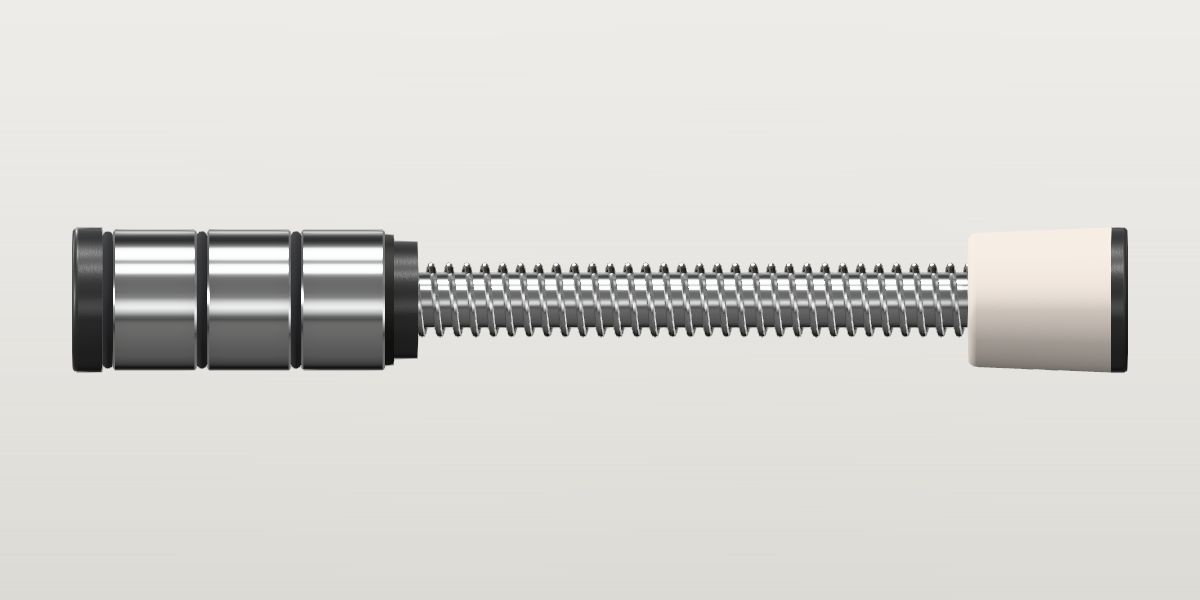
- Weight
- 5.3 oz ± 0.05 oz Conflictpublished: JP Enterprises, GEN 2 Silent Captured Spring for AR-15 type rifle #JPSCS2-15 (the maker's store page), the maker, read Oct 18, 2026Its sources span 5.25 oz to 6.25 oz.
- Lowest price
- $115.95 at AR15Discounts, read Nov 21, 2026
- Maker's number
- JPSCS2-15
- Colour
- Black (placeholder)
- Drawn as
- modelled
- Maker's page
- jprifles.com
In “BCM 16 in mid-length”, a build on the start page, in place of its BCM Carbine Buffer.
Its figures
Every figure the site draws and checks it by, with where it came from. Open one for each source's reading, and why one is used where they differ.
The buffer's mass: the slider with its three weights, which the carrier drives (what a buffer's class is)2.9 oz ± 0.05 ozConfirmedPublished: JP Enterprises, GEN 2 Silent Captured Spring for AR-15 type rifle #JPSCS2-15 (the maker's store page), the maker, read Oct 18, 2026
Published “Buffering/Reciprocating Mass: 2.9 oz. (Ideal for replacing a standard buffer of the same weight)” used
JP Enterprises, GEN 2 Silent Captured Spring for AR-15 type rifle #JPSCS2-15 (the maker's store page), the maker, read Oct 18, 2026 the page, harvested Oct 18, 2026
JP's FAQ has the table it comes from: "SCS Mass Configuration Buffer Mass AR-15 AR-10 3 Steel 2.9 oz. JPSCS2-15 JPSCS2-10 1 Tungsten | 2 Steel (H) 4.0 oz. ... 2 Tungsten | 1 Steel (H2) 4.8 oz. JPSCS2-15H2 ... 3 Tungsten (H3) 5.6 oz. JPSCS2-15H3" (https://jprifles.com/1.4.7.2_os.php?menu_select=scs_guide). The instruction sheet: "one with all steel masses that equates to a standard carbine buffer".
How far the unit stands out of the extension past the lower's face with the receivers open0.03 in ± 0.015 in 0.8 mmConfirmedPublished: JP Enterprises, GEN 2 Silent Captured Spring instruction sheet (JPSCS2-15, JPSCS2-10), Rev. 05.24, page 2, FITMENT, the maker, read Oct 18, 2026
Published “The SCS should protrude about .030”, which is the width of the included spacer shim.” used
JP Enterprises, GEN 2 Silent Captured Spring instruction sheet (JPSCS2-15, JPSCS2-10), Rev. 05.24, page 2, FITMENT, the maker, read Oct 18, 2026 the page, harvested Oct 18, 2026
The ± reaches the low end of the washer sheet's window (.015 to .060) printed on the same page.
JP's FAQ: "With the action open, the JPSCS should protrude from the buffer tube very slightly, 1/16" or less. If it's below flush then it won't reliably push the bolt carrier all the way to closed." Taken to be past the lower's face (the buffer tower's front face, std.ar15.buffer_tower_front_x), where the shim washer's sheet measures it ("check for proper protrusion from the receiver face. If it is between .015" and .060" then the SCS2-WASHER need not be used."): measured from the extension's own front end, 0.04 in further back, the unit as photographed would not reach the carrier at all.
The unit's length in the rifle, bolt forward (the slider's front face on the carrier to the extension's rear wall)7.226 in ± 0.03 in 183.5 mmProvisionalWorked out: {std.carbine_buffer.head_thickness} + {bcm-carbine-action-spring.installed_length}
Worked out 7.226 in ± 0.03 in used
{std.carbine_buffer.head_thickness} + {bcm-carbine-action-spring.installed_length}, harvested
The room a carbine buffer and its spring have: a buffer's front face rests at the upper receiver's rear face, and the spring's room runs from the head's rear face to the tube's rear wall (bcm-carbine-action-spring.installed_length). What the model is drawn at.
Length out of the rifle (the slider's front face to the end cap's rear face)7.249 in ± 0.04 in 184.1 mmProvisionalWorked out: {.installed_length} + {std.ar15.buffer_tower_front_x} + {.protrusion} - {std.ar15.upper_rear_face_x}
Worked out 7.249 in ± 0.04 in used
{.installed_length} + {std.ar15.buffer_tower_front_x} + {.protrusion} - {std.ar15.upper_rear_face_x}, harvested
From the tube's rear wall to the lower's face, and JP's .030 past it: the length the unit stands at out of the rifle, the slider on its stop. Closing the receivers pushes the slider back by what is left, 0.023 in, which is the "good tension against the bolt carrier" JP asks for.
Published “Length: Silent Captured Spring System: 7"”
Wing Tactical, JP Enterprises Silent Captured Spring AR-15 Buffer System (Gen 2) (one page for the standard and the H2), a seller, read Oct 18, 2026 the page, harvested Oct 18, 2026
The maker's own fitting figure over the standard extension's room; one seller's 7 in, to the inch, holds it. AR15Discounts' shop field "Dimensions 3.8 × 0.8 × 0.8 in" is no length of the unit (its slider alone is 2.4 in and its spring longer).
The rifle-length spacer's length (in the box; not drawn: it goes behind the unit in a rifle-length extension)2.7 in ± 0.05 in 68.6 mmProvisionalPublished: Wing Tactical, JP Enterprises Silent Captured Spring AR-15 Buffer System (Gen 2), a seller, read Oct 18, 2026
Published “Spacer: 2.7"” used
Wing Tactical, JP Enterprises Silent Captured Spring AR-15 Buffer System (Gen 2), a seller, read Oct 18, 2026 the page, harvested Oct 18, 2026
The narrowest rear channel of a bolt carrier the guide rod passes into while cycling0.53 in ± 0.0005 in 13.5 mmConfirmedPublished: JP Enterprises, Buffer Springs and Silent Captured Springs (FAQ), the maker, read Oct 18, 2026
Published “This is because the guide rod of the SCS needs to pass into the carrier during cycling, and some alternate designs don't have adequate space. Mil-spec bore for the rear channel of a bolt carrier is .625, but the SCS will work with carriers down to .530".” used
JP Enterprises, Buffer Springs and Silent Captured Springs (FAQ), the maker, read Oct 18, 2026 the page, harvested Oct 18, 2026
Diameter of the three weights (the buffer's widest steel)0.966 in ± 0.016 in 24.5 mmProvisionalPhoto: MidwayUSA 767861, the standard unit square to its side on white, 2200 x 1650
Photo 0.966 in ± 0.016 in used
MidwayUSA 767861, the standard unit square to its side on white, 2200 x 1650, harvested
Scale: the unit's length out of the rifle (.length, 7.249 in) over its 2117 px: 292.0 px/in. Read by the weights' silhouette, 282 px from top to bottom along all three (threshold 235 of 255; 281 to 283 px)
Under a standard carbine buffer's head (0.98) and the extension's 1.000 bore.
Diameter of the slider's front flange (black), the face the carrier bears on0.993 in ± 0.016 in 25.2 mmCorroboratedPhoto: a photo on file
Photo 0.993 in ± 0.016 in used
a photo on file, harvested
Scale: 292.0 px/in (.length). Read by the flange's silhouette, 290 px, px 2106 to 2148
Photo 0.978 in ± 0.016 in
Primary Arms' JPSCS2-15_01 on its page for the standard, the same picture at Dirty Bird and AR15Discounts: the unit square to its side on white, 2000 x 1333, front at the left, harvested
Scale: the unit's length out of the rifle (.length, 7.249 in) over its 1683 px (px 158 to 1841): 232.2 px/in. Read by the flange's silhouette, 227 px, px 172 to 205
Inside the ± of the reading above; the black collar and flange read 2% under MidwayUSA's throughout, which the two lenses' distances would give.
MidwayUSA's photo is the one every size of the slider is read on; Primary Arms' reads its black pieces 1.5 to 2% smaller throughout, one scale against another. Both are under the extension's 1.000 bore.
Length of the front flange0.209 in ± 0.01 in 5.3 mmProvisionalPhoto: a photo on file
Photo 0.209 in ± 0.01 in used
a photo on file, harvested
Scale: 292.0 px/in (.length). Read by from the front end (px 2164) to the flange's rear edge where the O-ring's dark band begins (px 2103), 61 px
The round on the flange's front edge0.045 in ± 0.015 in 1.1 mmProvisionalPhoto: a photo on file
Photo 0.045 in ± 0.015 in used
a photo on file, harvested
Scale: 292.0 px/in (.length). Read by the silhouette falls from the flange's full height at px 2151 to the end at px 2164, 13 px; the H2's front view (708eab533a4c) shows the edge broken all round
Width of each O-ring's band between the flange and a weight and between two weights0.072 in ± 0.016 in 1.8 mmProvisionalPhoto: a photo on file
Photo 0.072 in ± 0.016 in used
a photo on file, harvested
Scale: 292.0 px/in (.length). Read by the three bands from a weight's edge to the next: 15 px behind the flange (px 2088 to 2103) and 24 px between the weights (px 1899 to 1923, 1707 to 1731), 18 px of each of those dark; their mean, 21 px. The slider's pieces as drawn come to its 691 px with it
JP's weights sheet: "One O-ring should be positioned on every side of the weights except in the space between the weight and the snap ring." (https://jprifles.com/document_pdfs/JPSCS2HMSM_948.pdf)
Diameter of the O-rings as they show between the weights0.942 in ± 0.016 in 23.9 mmProvisionalPhoto: a photo on file
Photo 0.942 in ± 0.016 in used
a photo on file, harvested
Scale: 292.0 px/in (.length). Read by the silhouette at the dark bands, 274 to 277 px
Length of one weight0.572 in ± 0.01 in 14.5 mmProvisionalPhoto: a photo on file
Photo 0.572 in ± 0.01 in used
a photo on file, harvested
Scale: 292.0 px/in (.length). Read by edge to edge of each weight: 165, 168 and 168 px (px 1923 to 2088, 1731 to 1899, 1539 to 1707)
Weights on the slider3ConfirmedPublished: JP Enterprises, Buffer Springs and Silent Captured Springs (FAQ: SCS Mass Configuration), the maker, read Oct 18, 2026
Published “3 Steel 2.9 oz. JPSCS2-15” used
JP Enterprises, Buffer Springs and Silent Captured Springs (FAQ: SCS Mass Configuration), the maker, read Oct 18, 2026 the page, harvested Oct 18, 2026
Of the three weights, how many are tungsten0ConfirmedPublished: JP Enterprises, Buffer Springs and Silent Captured Springs (FAQ: SCS Mass Configuration), the maker, read Oct 18, 2026
Published “3 Steel 2.9 oz. JPSCS2-15” used
JP Enterprises, Buffer Springs and Silent Captured Springs (FAQ: SCS Mass Configuration), the maker, read Oct 18, 2026 the page, harvested Oct 18, 2026
Width of the snap ring's band behind the rearmost weight0.062 in ± 0.01 in 1.6 mmProvisionalPhoto: a photo on file
Photo 0.062 in ± 0.01 in used
a photo on file, harvested
Scale: 292.0 px/in (.length). Read by px 1521 to 1539, 18 px, between the black collar and the rearmost weight
JP's weights sheet: "Remove the snap ring from the SCS mass assembly by using the tip of a small screwdriver to pry up the end of the ring and slide it off the back side of slider."
Diameter of the snap ring as it shows0.897 in ± 0.025 in 22.8 mmProvisionalPhoto: a photo on file
Photo 0.897 in ± 0.025 in used
a photo on file, harvested
Scale: 292.0 px/in (.length). Read by the silhouette there, 255 to 268 px
Diameter of the slider's black rear collar, which the spring bears on0.805 in ± 0.012 in 20.4 mmCorroboratedPhoto: a photo on file
Photo 0.805 in ± 0.012 in used
a photo on file, harvested
Scale: 292.0 px/in (.length). Read by the collar's silhouette, 235 px, px 1476 to 1521
Photo 0.788 in ± 0.012 in
Primary Arms' JPSCS2-15_01 on its page for the standard, the same picture at Dirty Bird and AR15Discounts: the unit square to its side on white, 2000 x 1333, front at the left, harvested
Scale: 232.2 px/in (.length over 1683 px). Read by the collar's silhouette, 183 px, px 670 to 703
MidwayUSA's photo is the one every size of the slider is read on, so the slider's proportions are one photo's; Primary Arms' reads the flange and the collar alike 1.5 to 2% smaller, one scale's difference between the two pictures, not the collar's own.
Length of the rear collar0.164 in ± 0.01 in 4.2 mmProvisionalPhoto: a photo on file
Photo 0.164 in ± 0.01 in used
a photo on file, harvested
Scale: 292.0 px/in (.length). Read by px 1473 to 1521, 48 px
Diameter of the bore in the slider's front face (the guide rod's screw is at its bottom)0.546 in ± 0.04 in 13.9 mmProvisionalPhoto: Primary Arms' JPSCS2-15H2_01, the H2 from ahead of its front face, 2200 x 1467: the same slider and flange as the standard's, its weights tungsten
Photo 0.546 in ± 0.04 in used
Primary Arms' JPSCS2-15H2_01, the H2 from ahead of its front face, 2200 x 1467: the same slider and flange as the standard's, its weights tungsten, harvested
Scale: the flange's own diameter (.flange_d) across the face's ellipse. Read by the bore's long axis over the flange's along the same line, 0.55: a ratio along an ellipse's long axis is true whatever the lean
Wider than the carrier's narrowest channel JP names (.530): the rod's head, not the bore, goes into the carrier.
Depth of that bore to the screw's head (unit out of the rifle)0.25 in ± 0.1 in 6.3 mmProvisionalWorked out: An assumption for the drawing, not a reading: no view on file shows the bore in section. Wing Tactical's view of a front face (26c0d1ee43a2) has the screw's head well down in it, under its own diameter's depth.
Worked out 0.25 in ± 0.1 in used
An assumption for the drawing, not a reading: no view on file shows the bore in section. Wing Tactical's view of a front face (26c0d1ee43a2) has the screw's head well down in it, under its own diameter's depth., harvested
Bore of the weights (the slider's tube under them)0.805 in ± 0.012 in 20.4 mmCorroboratedWorked out: {.collar_d}
Worked out 0.805 in ± 0.012 in used
{.collar_d}, harvested
An assumption for the drawing, not a reading: the weights' insides never show. Taken to be the slider's tube, whose rear end is the black collar seen behind the snap ring (JP's weights sheet: the weights come off "the back side of slider" once the snap ring is off). app/tests/jp-silent-captured-spring-gen2.test.ts holds the slider so drawn to JP's 2.9 oz.
Bore through the slider from its rear to its inner flange, which the spring's front end goes into (and the bumper's, which its rear end goes into)0.53 in ± 0.02 in 13.5 mmProvisionalWorked out: An assumption for the drawing, not a reading: the bore never shows but at its mouth, behind the spring's coils. The spring's outside (.spring_od) and a clearance, by the patent's words.
Worked out 0.53 in ± 0.02 in used
An assumption for the drawing, not a reading: the bore never shows but at its mouth, behind the spring's coils. The spring's outside (.spring_od) and a clearance, by the patent's words., harvested
The maker's patent: "The buffer 22 has a slider 28 with a central bore 134 that defines an interior surface 40. The central bore is sufficiently large to receive the front 54 of the bolt return spring 52. A flange 36 protrudes inwardly from the interior surface to define an aperture 94 and to limit forward movement of the bolt return spring." And of the bumper: "The resilient portion has a central bore 62 that defines an interior surface 68. The central bore is sufficiently large to permit passage of the rear 16 of the guide rod 12 and to receive the rear 56 of the bolt return spring 52."
The slider's inner flange: how thick it is, behind the front bore (the front screw's head bears on it from ahead, the spring from behind)0.1 in ± 0.05 in 2.5 mmProvisionalWorked out: An assumption for the drawing, not a reading: no view shows the slider in section; the patent's FIG. 1B draws the flange about a twentieth of the slider's length, a drawing of the first generation and not to a stated scale.
Worked out 0.1 in ± 0.05 in used
An assumption for the drawing, not a reading: no view shows the slider in section; the patent's FIG. 1B draws the flange about a twentieth of the slider's length, a drawing of the first generation and not to a stated scale., harvested
The maker's patent: "Forward motion of the buffer 22 is constrained by the head 48 of a front screw 46. ... The head is sized with a diameter such that the head extends outwardly beyond the guide rod and is too large to pass through the aperture 94 defined by the flange 36 in the slider 28." "The front 54 of the spring abuts the flange 36 of the slider".
The end cap's spigot inside the bumper's rear half (its front, which carries the spring's rear end)0.7 in ± 0.08 in 17.8 mmProvisionalWorked out: An assumption for the drawing, not a reading: the spigot never shows. Between the spring's bore (.slider_bore_d) and the bumper's outside, as the patent's FIG. 1B draws it.
Worked out 0.7 in ± 0.08 in used
An assumption for the drawing, not a reading: the spigot never shows. Between the spring's bore (.slider_bore_d) and the bumper's outside, as the patent's FIG. 1B draws it., harvested
The maker's patent: "The interior surface also defines a ledge 64 at a point approximately midway between the front and the rear. The front 78 of the end cap 76 is inserted into the rear 72 of the bore 62 of the resilient portion 60 and abuts the ledge 64. ... the rear 56 of the spring abuts the rear of the central bore 84 in the end cap." In the patent's embodiment "the resilient portion is made of urethane and the end cap is made of steel".
The break on each weight's edges0.014 in ± 0.007 in 0.4 mmProvisionalPhoto: a photo on file
Photo 0.014 in ± 0.007 in used
a photo on file, harvested
Scale: 292.0 px/in (.length). Read by the silhouette drops from 281 to 273 px over the last 3 to 6 px of each weight: 4 px a side
Diameter of the guide rod (aluminium)0.377 in ± 0.012 in 9.6 mmProvisionalPhoto: a photo on file
Photo 0.377 in ± 0.012 in used
a photo on file, harvested
Scale: 292.0 px/in (.length). Read by the rod's two edges between the coils along the whole spring: the commonest top edge row 769 and bottom 878, 110 px
Under JP's .530 carrier channel, which it has to enter.
Wing Tactical: "Material: Guide Rod: Aluminum Buffer Weights: Tungsten and Steel".
The spring's outside diameter0.51 in ± 0.015 in 13 mmProvisionalPhoto: a photo on file
Photo 0.51 in ± 0.015 in used
a photo on file, harvested
Scale: 292.0 px/in (.length). Read by a coil's top crest to its bottom crest, 146 px; the envelope of all the coils, 153 px (0.524) with their lean
The spring's wire0.047 in ± 0.004 in 1.2 mmProvisionalPhoto: a photo on file
Photo 0.047 in ± 0.004 in used
a photo on file, harvested
Scale: 292.0 px/in (.length). Read by a coil's width across its wire where it crosses the rod, 13 to 14 px, on crops at twice the size
The spring's turns, end to end31 ± 1ConflictPhoto: Primary Arms' JPSCS2-15_01 on its page for the standard, the same picture at Dirty Bird and AR15Discounts: the unit square to its side on white, 2000 x 1333, front at the left
Photo 28.5 count ± 0.5 count
a photo on file, harvested
Scale: none: a count. Read by the crests along the spring's top edge, counted on two crops at twice the size (px 360 to 940 and 900 to 1500, overlapping at one crest): 29 crests 38.8 px apart from the coil on the bumper's face to the coil on the collar, and the ends between
JP: "The AR-15 models comes with a 15-85 spring"; the kit's sheet has it "Black - Uncolored" at its ends. Its free length isn't on a page. The count is of what shows between the collar and the bumper: the spring runs on inside both (the patent), drawn at the same pitch.
Photo 30.5 count ± 0.5 count used
Primary Arms' JPSCS2-15_01 on its page for the standard, the same picture at Dirty Bird and AR15Discounts: the unit square to its side on white, 2000 x 1333, front at the left, harvested
Scale: none: a count. Read by the crests along the spring's top edge on two crops at 2.2 times the size (px 690 to 1160 and 1140 to 1610, overlapping at one crest): 31 crests 28.6 px apart, from the coil on the collar (px 715) to the coil on the bumper's face (px 1574)
The spring is black for two thirds of its length from the bumper and bare toward the collar: JP's kit sheet codes the standard's spring so, "JPSCS-15-85* Black - Uncolored" with "* JPSCS2-15" (https://jprifles.com/document_pdfs/JPSCS2%20Kit_911.pdf).
Two runs of the product under one number, two coils apart. Primary Arms' spring carries the colour code JP gives the standard's 15-85 spring; MidwayUSA's is bare all along and its pitch coarser (0.132 against 0.123 in), another spring or another run.
photo and pa differ by 2 beyond what each states it is good to.
Length of the polymer bumper, from the end cap to its front face0.979 in ± 0.012 in 24.9 mmCorroboratedPhoto: a photo on file
Photo 0.979 in ± 0.012 in used
a photo on file, harvested
Scale: 292.0 px/in (.length). Read by px 94 (where the black cap ends) to px 380 (the front face, where the silhouette meets the spring's), 286 px
Photo 0.969 in ± 0.012 in
Primary Arms' JPSCS2-15_01 on its page for the standard, the same picture at Dirty Bird and AR15Discounts: the unit square to its side on white, 2000 x 1333, front at the left, harvested
Scale: 232.2 px/in (.length over 1683 px). Read by px 1589 (the front face, where the silhouette meets the spring's) to px 1814 (where the cap's black begins), 225 px
The two agree inside their ±; MidwayUSA's, the photo the bumper's diameters are read on.
The bumper's diameter at its rear (it tapers toward the front)0.993 in ± 0.016 in 25.2 mmProvisionalPhoto: a photo on file
Photo 0.993 in ± 0.016 in used
a photo on file, harvested
Scale: 292.0 px/in (.length). Read by 290 px at px 118 to 150, beside the cap's 291
The bumper's diameter at its front face0.918 in ± 0.016 in 23.3 mmProvisionalPhoto: a photo on file
Photo 0.918 in ± 0.016 in used
a photo on file, harvested
Scale: 292.0 px/in (.length). Read by 268 px at px 352, falling evenly from 290 at px 118 (283 at 200, 277 at 250, 273 at 300)
The round on the bumper's front edge0.06 in ± 0.02 in 1.5 mmProvisionalPhoto: a photo on file
Photo 0.06 in ± 0.02 in used
a photo on file, harvested
Scale: 292.0 px/in (.length). Read by the silhouette falls over 28 px (px 352 to 380), of which the face itself, seen a few degrees off edge-on, is about 10
Diameter of the black end cap at the rear0.996 in ± 0.016 in 25.3 mmProvisionalPhoto: a photo on file
Photo 0.996 in ± 0.016 in used
a photo on file, harvested
Scale: 292.0 px/in (.length). Read by 291 px, px 79 to 94
Length of the end cap0.116 in ± 0.01 in 2.9 mmConflictPhoto: Primary Arms' JPSCS2-15_01 on its page for the standard, the same picture at Dirty Bird and AR15Discounts: the unit square to its side on white, 2000 x 1333, front at the left
Photo 0.161 in ± 0.012 in
a photo on file, harvested
Scale: 292.0 px/in (.length). Read by px 47 (the rear end) to px 94, 47 px, black throughout
Photo 0.116 in ± 0.01 in used
Primary Arms' JPSCS2-15_01 on its page for the standard, the same picture at Dirty Bird and AR15Discounts: the unit square to its side on white, 2000 x 1333, front at the left, harvested
Scale: 232.2 px/in (.length over 1683 px). Read by the black band from where the pale bumper ends (px 1814) to the rear end (px 1841), 27 px, its rear rim's round 9 px of it
The cap's band at full height is the same in both photos (23 px at 292.0 and 18 px at 232.2: 0.079 and 0.078 in); in MidwayUSA's the rear rim adds 24 px more, in Primary Arms' 9: its lens stood nearer, and the face's rim it sees past the edge isn't the cap's length.
photo and pa differ by 0.045 in beyond what each states it is good to.
The round on the end cap's rear edge0.035 in ± 0.01 in 0.9 mmCorroboratedPhoto: Primary Arms' JPSCS2-15_01 on its page for the standard, the same picture at Dirty Bird and AR15Discounts: the unit square to its side on white, 2000 x 1333, front at the left
Photo 0.05 in ± 0.025 in
a photo on file, harvested
Scale: 292.0 px/in (.length). Read by the silhouette rises from 118 px at px 49 to its full height at px 73: 24 px, of which the rear face's rim, seen a few degrees off edge-on, is part
Photo 0.035 in ± 0.01 in used
Primary Arms' JPSCS2-15_01 on its page for the standard, the same picture at Dirty Bird and AR15Discounts: the unit square to its side on white, 2000 x 1333, front at the left, harvested
Scale: 232.2 px/in (.length over 1683 px). Read by the silhouette falls from full height to the end over 9 px (px 1832 to 1841): no more than that is the round
The smaller of the two: what the end's silhouette falls over is the round and, more in the nearer lens's photo, the rear face's rim.
The pocket in the end cap's rear face that the rear screw's head sits in0.42 in ± 0.05 in 10.7 mmProvisionalPhoto: Primary Arms' JPSCS2-15H2_02, the H2 from behind its end cap, 2200 x 1467: the same cap as the standard's, "US 8,800,424" on its face
Photo 0.42 in ± 0.05 in used
Primary Arms' JPSCS2-15H2_02, the H2 from behind its end cap, 2200 x 1467: the same cap as the standard's, "US 8,800,424" on its face, harvested
Scale: the cap's own diameter (.cap_d) across the face's ellipse. Read by the pocket's long axis over the face's along the same line, 0.42, read on a crop at twice the size
The rear screw's head0.36 in ± 0.05 in 9.1 mmProvisionalPhoto: a photo on file
Photo 0.36 in ± 0.05 in used
a photo on file, harvested
Scale: the cap's own diameter (.cap_d) across the face's ellipse. Read by the head's long axis inside the pocket over the face's, 0.36
The screws' hex socket, across its flats0.125 in ± 0.002 in 3.2 mmConflictPublished: JP Enterprises, Buffer Springs and Silent Captured Springs (FAQ), the maker, read Oct 18, 2026
Published “GEN 2 SCS units take a 1/8 hex wrench.” used
JP Enterprises, Buffer Springs and Silent Captured Springs (FAQ), the maker, read Oct 18, 2026 the page, harvested Oct 18, 2026
On the H2's end cap (0c20449e5d5c) the socket reads 0.13 of an inch by the cap's own diameter: the same. The kit's sheet calls the front screw "this 10-32 screw" with "a T25 key", which is another production's.
Published “Before disassembly, note that the SCS screws are metric and require a 3mm hex key.”
JP Enterprises, Silent Captured Spring Selection Guide (Ver. 11.24, "the GEN 2 Silent Captured Spring System"), page 6, V Compatibility Modifications, Changing Springs, the maker, read Oct 18, 2026 the page, harvested Oct 18, 2026
3 mm. The FAQ says this is the first generation's: "The screws on the first generation JPSCS are metric (M5) and take a 3mm hex key."
The FAQ names the GEN 2's key and gives the 3 mm to the first generation, whose sentence the guide carries over; the H2's end cap reads 0.13 in across its socket, nearer 1/8 than 3 mm.
jp and guide differ by 0.007 in beyond what each states it is good to.
Depth of the end cap's pocket to the screw's head0.05 in ± 0.03 in 1.3 mmProvisionalWorked out: An assumption for the drawing, not a reading: the H2's rear view (0c20449e5d5c) has the head a little below the face, and no view shows it in section.
Worked out 0.05 in ± 0.03 in used
An assumption for the drawing, not a reading: the H2's rear view (0c20449e5d5c) has the head a little below the face, and no view shows it in section., harvested
What it goes with
By the way it mounts, and the figures each part on file states: a part whose figures say it doesn't fit is left out, and one whose fit can't be checked from what is published is marked. A check is against published figures, not a guarantee.
Receiver extension bore
- Receiver extensions
- BCM Milspec Carbine Receiver Extension (Buffer Tube) 6 Position, BCM MK2 Receiver Extension, Geissele Automatics Premium Mil-Spec Buffer Tube, Guntec USA AR-15 Mil-Spec Buffer Tube (Gen 2), SB Tactical SBPDW receiver extension, housing and integral castle nut, VLTOR RE-A5 7-Position Receiver Extension, MilSpec Diameter
Prices on file
Each seller's latest reading of its own page: before tax and shipping, and not a quote. The pages are read again every night.
- AR15Discounts $115.95 Nov 21, 2026, in stock that day
- Silencer Shop $125.00 Nov 21, 2026, stock not said
- Primary Arms $125.96 Nov 21, 2026, in stock that day
- MidwayUSA $132.95 Nov 21, 2026, in stock that day
- Dirty Bird Industries $139.95 Nov 21, 2026, in stock that day